
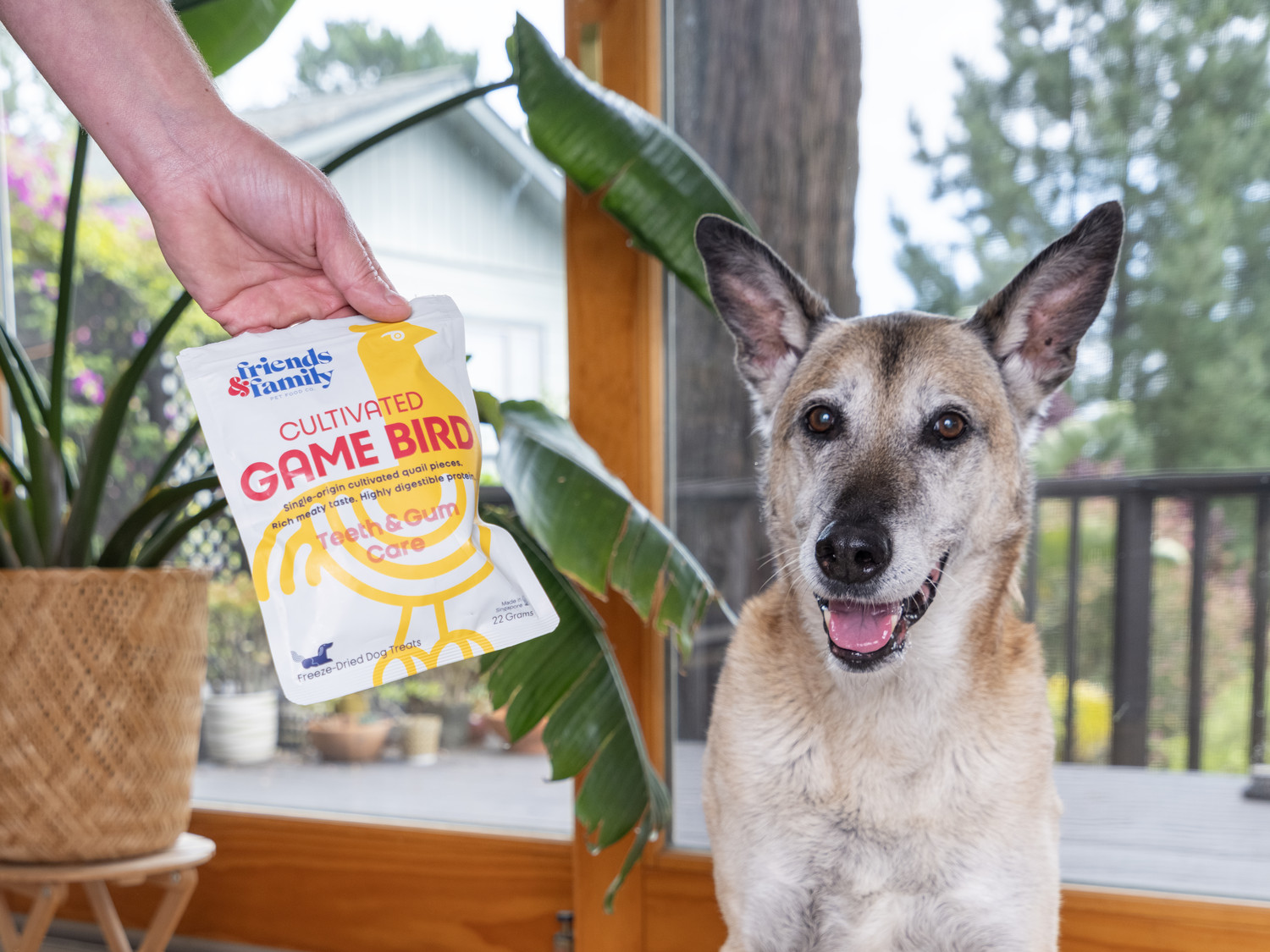
There has never been more meat in pet food.
In 2024 alone, over 4.5 million tons of meat, poultry, marine proteins, rendered meals and fats were used in American pet food. Variety is expanding just as quickly. Clean label, “biologically appropriate,” human-grade and novel proteins have pushed the industry toward more types of meat than ever before — from kangaroo to crocodile to seal.
So if pets are eating more meat than ever, and we have more novel animal proteins than ever, why do we even need cultivated meat? Surely we have meat for pets covered by now!
My reason: I think we can do better.
Looking at the shelves at any quality pet store, it will seem like there’s not much room for improvement. The greatest possible version of kibble is already on that shelf. The freshest, healthiest frozen meals can be found online. Training treats likely can’t get any better.
To meaningfully improve upon the status quo, you need to look beyond those products, and the ingredients in them. To create a nutrition system that syncs with our pets' biology.
And that brings me back to the idea of doing better. The pet food model has not changed much in the last 70 years, and neither has the underlying protein system. It's processed meat, no matter if it's chicken or alligator.
Most of the nutritional innovation in pet food over the past 20 years has come from additives — probiotics, synthetic amino acids, fiber blends, omega-3 fatty acids. The protein itself remains sourced from the same commodity supply chains that have always defined the commercial pet industry.
This system has served cats and dogs fairly well – for instance, commercial pet food is the primary reason you will likely not run into a puppy with rickets.
But it’s time for an evolution, and cultivated meat is exactly that.
It is not an additive, or a fortifier. It is most certainly not processing. It is a nutrient platform — a novel production system, under controlled conditions, with defined composition and reproducible quality. It’s a better meat.
That is the difference.
The question isn’t how much meat is in pet food. It’s how that meat is produced, and from there, what ends up in your cat or dog’s bowl.
Our fundamental goal is to improve nutrition for cats and dogs, so they can live longer, happier lives, and in turn we can live longer, happier lives with our animals.
So in the spirit of improvement, in this series, I looked at the proteins you’d typically see listed on the ingredient labels of cat and dog foods and tried to objectively identify the weaknesses of these proteins. Where can cultivated meat improve upon the current commercial pet foods?
A series on protein in pet food
What goes into the bowl, ingredient by ingredient